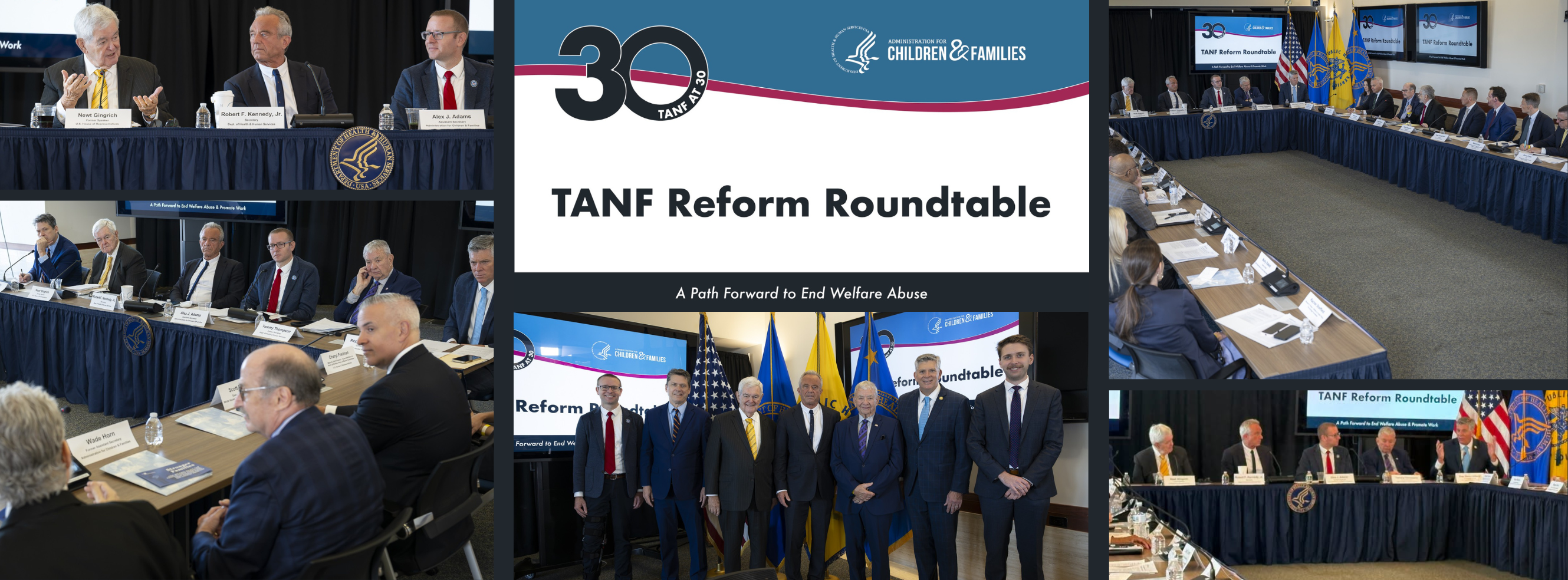
TANF at 30
Landmark Dates for TANF
From the Director of the Office of Family Assistance:
- Thirty Years Later, Welfare Reform Needs Its Own Reform
- TANF and Work: The Gap Between Perception and Reality
- TANF and Work: The Caseload Reduction Credit and How States Exploit It
- The Prevalence of TANF Child-Only Cases Involving Immigration-Status-Ineligible Parents
- Safeguarding TANF Assistance: State Options for EBT Location and Purchase Restrictions
Families are Stronger Together
Want practical ways to boost your program’s employment outcomes and help advance core purposes of Temporary Assistance for Needy Families (TANF)? The Office of Family Assistance is sponsoring The Family Routes Initiative (FRI) to assist…
Steady employment benefits both parents and children. This National Conference of State Legislatures resource highlights how child support agencies are partnering with workforce programs to connect parents with employment services that can…
This vignette features a Tribal Temporary Assistance for Needy Families (TANF) program that participated in the Family Routes Initiative Learning Community and expanded their Healthy Marriage and Responsible Fatherhood (HMRF) services. This…
This toolkit contains a collection of four one-page resources designed to facilitate strong, collaborative relationships with families. The toolkit includes flyers that can navigate Temporary Assistance for Needy Families (TANF) practitioners…
As the Temporary Assistance for Needy Families (TANF) program marks nearly 30 years, conversations about the program’s original intent is gaining renewed attention. This opinion piece reflects on how families, the workforce, and state programs…
The Administration for Children and Families announced a new Technical Assistance Center to help states, Tribes, and territories implement Fostering the…
Work Innovations
Temporary Assistance for Needy Families (TANF) programs often work alongside workforce systems to help families prepare for and find employment, but navigating those systems can be challenging when programs operate separately. This Jobs for the…
In August 2026, the Administration for Children and Families (ACF) and the Department of the Treasury jointly released a Frequently Asked Questions (FAQ) document to help states, territories, and Tribes establish and administer…
Access to education and training does not automatically translate into a good job. People also need help figuring out which opportunities make sense for their goals, how to pay for training, what credentials employers value, and what steps can…
Want practical ways to boost your program’s employment outcomes and help advance core purposes of Temporary Assistance for Needy Families (TANF)? The Office of Family Assistance is sponsoring The Family Routes Initiative (FRI) to assist…
Steady employment benefits both parents and children. This National Conference of State Legislatures resource highlights how child support agencies are partnering with workforce programs to connect parents with employment services that can…
This vignette features a Tribal Temporary Assistance for Needy Families (TANF) program that participated in the Family Routes Initiative Learning Community and expanded their Healthy Marriage and Responsible Fatherhood (HMRF) services. This…
Promoting Healthy Marriages and Two-Parent Families
The Office of Planning, Research and Evaluation’s Supporting Evaluation Efforts for Demonstrations in Self-Sufficiency (SEEDS) project provided evaluation support and capacity building to 20 Family Self-Sufficiency Demonstration Development (…
The Office of Family Assistance published data tables which show TANF and Separate State Programs-Maintenance of Effort (SSP-MOE) caseloads separately and combined by state and at the national level from October 2019 through June 2020. The tables…
The Office of Family Assistance published data tables which cover TANF and maintenance-of-effort separate caseloads and combined (TANF and SSP-MOE) by state and at the national level from October 2018 through September 2019. The tables are cross-…
This video covers highlights from the “Thriving Communities for a Better Southern Nevada” meeting that was held in Las Vegas, Nevada on January 10, 2020. This event, hosted by the Office of Family Assistance (OFA) and Las Vegas-Clark County, Nevada…
The U.S. Department of Health and Human Services (HHS), Administration for Children and Families (ACF), Office of Family Assistance (OFA), held the Helping Families to Overcome: Partnering to Build a Strong Society Meeting at the Crystal Gateway…
The Temporary Assistance for Needy Families (TANF) 12th Report to Congress from the Office of Family Assistance provides data from the TANF program from fiscal years 2014 and 2015. It presents information on expenditures, caseloads, work…